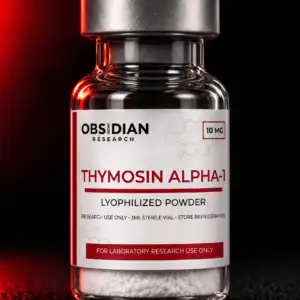

Research Overview
Thymosin Alpha-1 is an investigational peptide research compound that has generated scientific interest due to its interactions with immune-cell signaling pathways and molecular mechanisms involved in cellular regulation. Research surrounding Thymosin Alpha-1 has focused on understanding its biochemical properties and its role within controlled laboratory studies.
Scientific investigations continue to explore Thymosin Alpha-1’s relationship with T-cell signaling, cytokine-associated pathways, immune-cell activation, and cellular processes involved in molecular regulation and immunology research.
Areas of Research Interest Include:
- T-cell signaling research
- Immune-cell activation studies
- Cytokine-associated signaling pathways
- Cellular regulation mechanisms
- Immunology and molecular biology research
Scientific Background
Thymosin Alpha-1, also known as Tα1, is a 28-amino-acid acetylated peptide that has been studied for its interactions with immune-cell signaling and regulatory pathways. Laboratory research has examined its relationship with T-cell activation, cytokine signaling, and cellular responses associated with immune-system regulation.
Recent in-vitro research has also evaluated Thymosin Alpha-1 in human CD8+ T-cell models, including measurements of proliferation, activation markers, cytokine secretion, and cellular exhaustion-associated markers. These findings continue to contribute to a broader understanding of the peptide’s molecular and cellular characteristics within controlled research models.
Molecular Information
Molecular Formula: C129H215N33O55
Molecular Weight: 3108.3 g/mol
Research Context and Study Design
Research involving Thymosin Alpha-1 may be structured around controlled cellular or immune-signaling models in which investigators compare molecular responses across defined experimental conditions. Useful study designs generally keep assay timing, sample handling, concentrations, controls, culture conditions, and measurement methods consistent so that differences between groups can be interpreted more reliably.
Because peptide research involving immune-cell signaling can involve multiple downstream measurements, clearly defining the primary analytical endpoint before an experiment begins can improve data quality and reduce ambiguity when interpreting secondary observations.
Laboratory Documentation
For reproducible laboratory work, researchers may track lot information, sample identifiers, preparation and storage history, instrument settings, cell-culture conditions, and protocol versions. Maintaining these records makes it easier to compare results across separate experimental runs and identify procedural variables that may influence the data.
Research Use Only
Products offered by Obsidian Research are intended solely for laboratory research purposes. These products are not intended for human or veterinary consumption and are not approved for clinical use.
CONTINUE YOUR RESEARCH
Expand Your Laboratory Knowledge
Explore foundational resources relevant to Thymosin Alpha-1 and Peptide Research.
-
Understanding Molecular Weight in Research Compounds
Read Article → -
Understanding Purity Testing in Research Compounds
Read Article →
Related research materials
Featured research collection
Peptide Research
Explore complementary research materials organized around this area of laboratory investigation.